


LIDAR

Breakthrough in Multiplex Technology

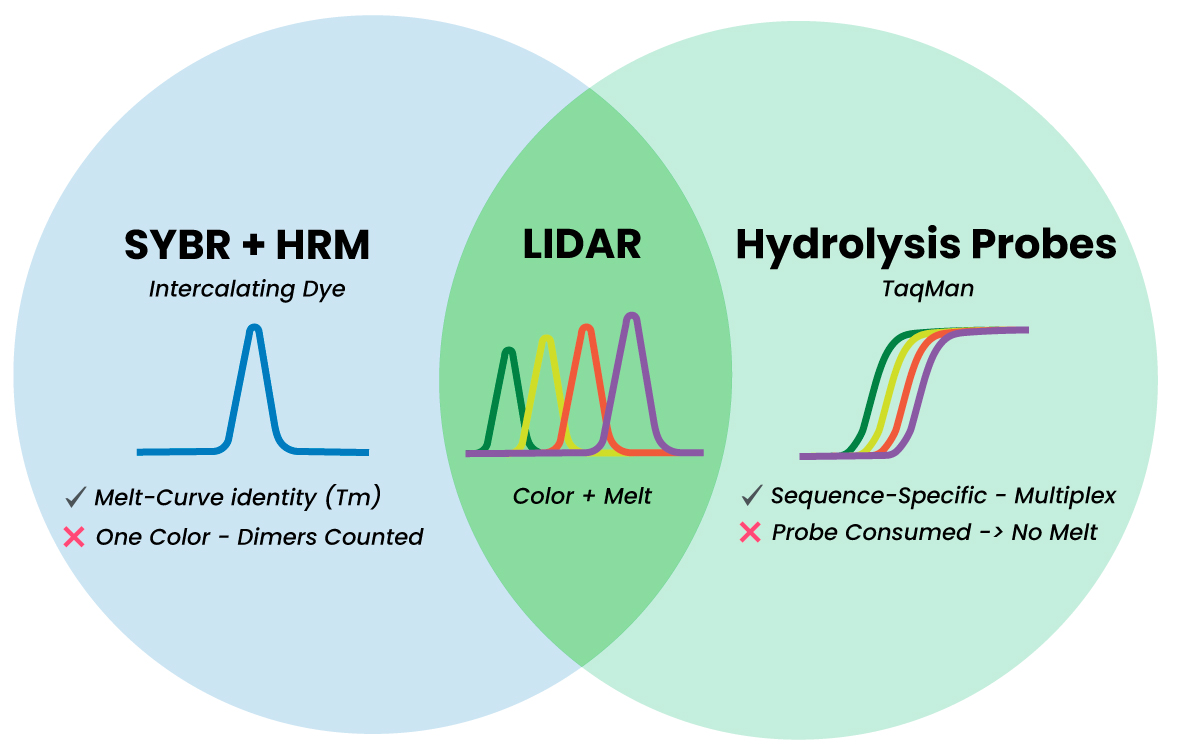
LIDAR (Longitudinal Identification via Amplified Reporters) is a breakthrough, patent-pending qPCR chemistry invented by Kevin McKernan. By combining Conventional qPCR’s fluorophore detection with High-Resolution Melting (HRM), LIDAR assays can detect up to 20 unique targets in a single reaction.

Applications

Microbial Safety

Expanding the number of pathogens detected in a single reaction

Clinical Diagnostics

Enabling comprehensive syndromic panels (e.g., respiratory or GI pathogens)

Research

Enabling comprehensive syndromic panels (e.g., respiratory or GI pathogens)

Agrigenomics

Providing a universal platform to design custom panels for up to 20 targets
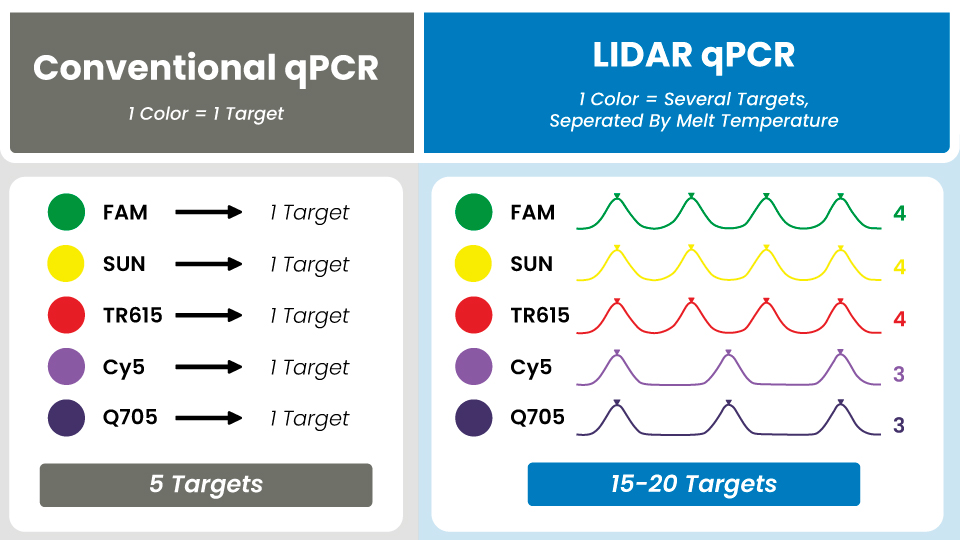
Adding a Second Dimension to qPCR Detection

Multiplexing with conventional qPCR assays is limited to the number of fluorophores the instrument can detect. By adding a second HRM step, LIDAR assays can group multiple targets on a single fluorophore and then tease out which specific targets are present based on the melting point. This expands multiplexing capabilities four-fold. 

Learn More about LIDAR

For a deeper technical walkthrough of how LIDAR works and
how it was developed, watch the full presentation below.

Want to Learn More
or Collaborate?

Use the form below to reach out! We’d love to share more information about LIDAR and discuss a collaboration.

MaGiC™ Lysis

Simplified DNA Extraction Process

SenSATIVAx®

Purify Plant and Microbial DNA

Grim Reefer®

Eliminate Dead DNA

PathoSEEK®

qPCR Detection Assays

PathoSEEK® ID

Identify Species in Failed Samples

FemINDICAtor®

Plant Sex Detection Assay

Mic & Myra

Automated Liquid Handling & qPCR

LIDAR

Breakthrough Multiplex Technology

Sequencing

Valuable Insights and Actionable Data

Fill form to watch Video